Learn Digital Marketing for Free vs a Paid Course: What You Actually Get
You can learn digital marketing for free, and plenty of people do. Free resources teach the concepts well, but a paid course adds what they usually lack: feedback on your work, reviewed projects and a clear order to follow.
What you can learn for free
Quite a lot. Google runs free training on its own tools through Google Skillshop, covering Google Ads and Analytics. Google’s SEO Starter Guide explains how search works. YouTube, blogs and free certificate courses fill in the rest.
For a first look at the subject, that is enough. You can learn what SEO is, how ads are priced, and what a funnel looks like without paying anything.
Where free learning stops working
Most people don’t quit free learning because the content is bad. They stall for other reasons:
- No order. Ten videos on ads, three on SEO, none telling you what to do first.
- No feedback. You write an ad, nobody tells you why it won’t convert.
- Tools without practice. Watching someone run a campaign is different from spending real budget and seeing the numbers.
- Nobody notices when you stop. There is no batch, no deadline, no one asking where you went.
If you are disciplined and already know what you want to learn, none of this matters much. If you are starting from zero, it matters a lot.
What a paid course adds
A digital marketing course vs self learning comes down to four things:
- A fixed path. Topics arrive in an order that makes sense, so you are never guessing what comes next.
- Feedback. Someone reviews your work and tells you what to change.
- Projects. You build things that go into a portfolio, not just a certificate.
- Pace and accountability. A schedule and a group keep you moving.
Table comparing free learning and a paid course
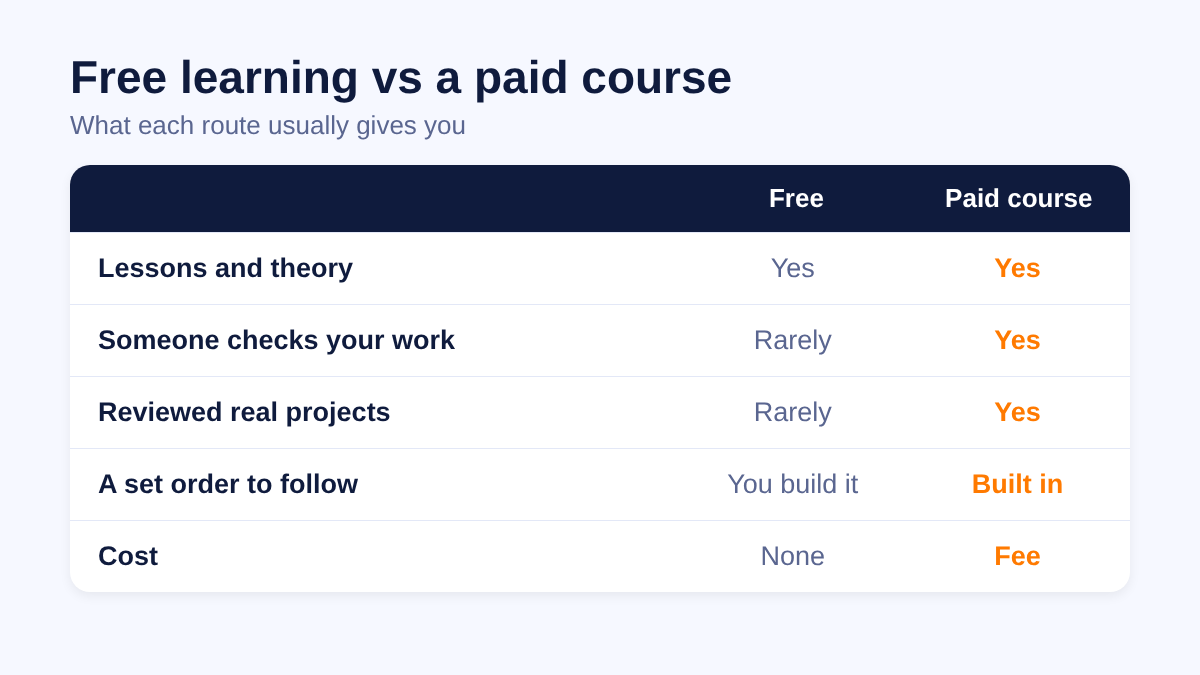
Not every paid course delivers these. Some are recorded videos with a certificate at the end, which is only free learning with a price tag. Check the points above before you pay.
A simple way to decide
| If this sounds like you | Start here |
|---|---|
| Curious, not sure you want a career in it | Free resources |
| Self-driven, know your goal | Free first, paid later if you stall |
| Want a job or freelance income soon | A paid course with projects and feedback |
| Have tried free and lost momentum | A paid course |
A sensible middle path: spend two weeks on free material. If you finish it and want more, you have your answer. If you stall, you have learned that you need structure, which is exactly what a course sells.
What to ask before paying
- Who reviews my work, and how often?
- How many real projects will I complete?
- What tools will I actually use, and do I get hands-on access?
- Can I see what the first three months look like? [Internal Link: what to expect in months 1 to 3 → 3-months post, URL needed]
- What is the full fee, and what is the refund policy?
Where DigiAdzo fits
If you want the structured route, the digital marketing course in Guwahati at DigiAdzo is built around classroom guidance and practical work. You can compare it against free options honestly, and our blog has more guides if you want to keep reading first.
The short version
Free resources are a good way to learn digital marketing for free and test whether you like it. A paid course earns its fee only if it gives you feedback, projects and structure. Try the free route for a couple of weeks, then decide with real information.